NJORD
R-Mode Transmitter | Reliable Positioning
in GNSS-Denied Environments
The Novator Solutions NJORD R-Mode Transmitter provides resilient, shore-based positioning corrections for maritime users operating in GNSS-denied or degraded environments. Integrating seamlessly with existing or newly established beacon infrastructure, it delivers robust navigation support using terrestrial medium frequency transmissions, ensuring safe and continuous positioning in critical maritime regions worldwide.
Key Facts
- Fully integrated R-Mode transmitter rack
- Compatible with existing and new MF (medium frequency) beacon infrastructure
- Includes high-stability clock, MSK (minimum shift keying) modulation module, and GNSS/GPS antennas
- Remote network configuration and monitoring
- Designed for continuous 24/7 maritime operation
- NJORD in Brief
- Features and benefits
- Applications
- Resources
- Specifications
- More Products
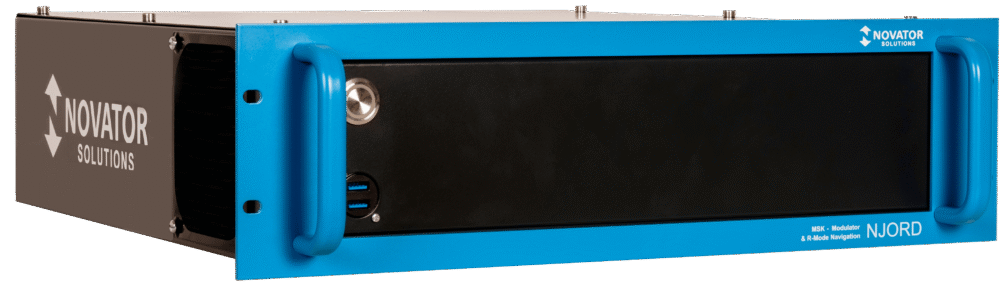
NJORD is a fully integrated, shore-based R-Mode transmitter designed to provide resilient maritime positioning in environments where GNSS is unavailable, degraded, or unreliable. Built on terrestrial medium-frequency transmissions, it enables safe navigation by delivering continuous ranging signals independent of satellite systems.
Developed for next-generation resilient navigation systems, NJORD is based on Ranging Mode (R-Mode) technology advanced through initiatives such as the Interreg Baltic Sea Region ORMOBASS project. It can be deployed at existing MF or DGPS beacon sites or installed as part of new dedicated R-Mode infrastructure, offering a cost-effective path to enhanced maritime safety.
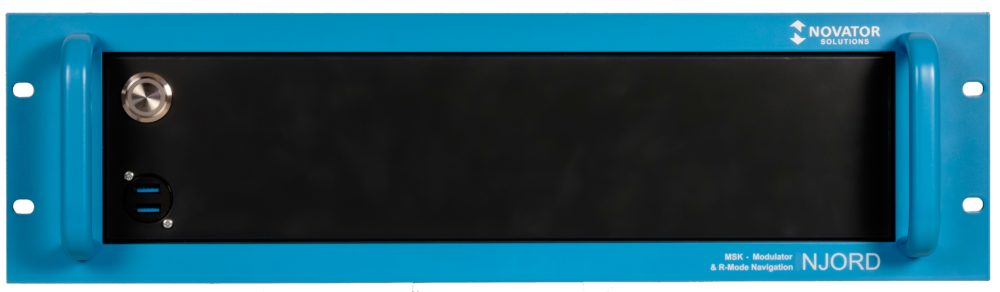
The transmitter integrates a high-stability reference clock, MSK and CW modulators, and GNSS/GPS antennas within a compact 19-inch rack-mounted unit. Secure remote network operation allows centralised monitoring, configuration, and performance management across multiple installations.
- Resilient positioning independent of GNSS
Provides a terrestrial alternative to satellite navigation, ensuring continuity during GNSS outages, interference, or intentional disruption.
- Leverages existing infrastructure
Compatible with existing MF and DGPS beacon installations, minimising deployment time and integration costs.
- High positioning accuracy
Delivers positioning accuracy typically between 10 and 100 metres, with daytime performance commonly in the 10–20 metre range, depending on network geometry and station availability.
- Designed for continuous operation
Engineered for 24/7 maritime use in harsh coastal environments, meeting stringent requirements for reliability and signal integrity.
- Remote monitoring and control
Enables secure, centralised network management across multiple shore stations via Ethernet-based interfaces.
- Maritime navigation in GNSS-denied or degraded environments
Supports safe vessel positioning in coastal waters, ports and critical maritime corridors.
- National and regional resilient PNT systems
Forms a key component of terrestrial positioning, navigation and timing (PNT) strategies.
- Backup and redundancy for satellite navigation
Complements GNSS by providing an independent positioning layer for safety-critical operations.
- Coastal and port authority infrastructure
Enhances maritime safety services through shore-based positioning support.
| Parameter | Specification |
|---|---|
| Transmission Type | MF R-Mode (MSK-modulated) |
| Frequency Range | 283.5 – 325 kHz |
| Frequency Resolution (MSK) | 500 Hz |
| Frequency Resolution (CW) | 1 Hz |
| Frequency Accuracy | < 1 µHz |
| Antenna Interface | 50 Ω terminated, 1 V peak-to-peak |
| Output Power | Configurable up to site limits |
| Reference Clock | 10 MHz and PPS (pulse-per-second) |
| Control Interface | Ethernet (remote network operation) |
| RTCM Interface | TCP / IP / RS 232 |
| Rack Format | 19” rack |
| Power Supply | 230 V AC, 50 Hz |